P42
Senior AI Advisory. Small, Local, and Accountable.
P42 is a fractional AI advisory firm serving small and midsize organizations with high-stakes data — human services and legal teams especially. I make organizations AI-ready — mapping where AI fits, guiding the technology you adopt, and building the data pipelines and automations that take repetitive work off your experts' desks, entirely within your own environment, so confidential data never leaves the building.
This is backed by twenty years of applied research and evaluation, ten of them in AI, with systems in statewide production use and trainings delivered internationally.
brian@parallel42.ai →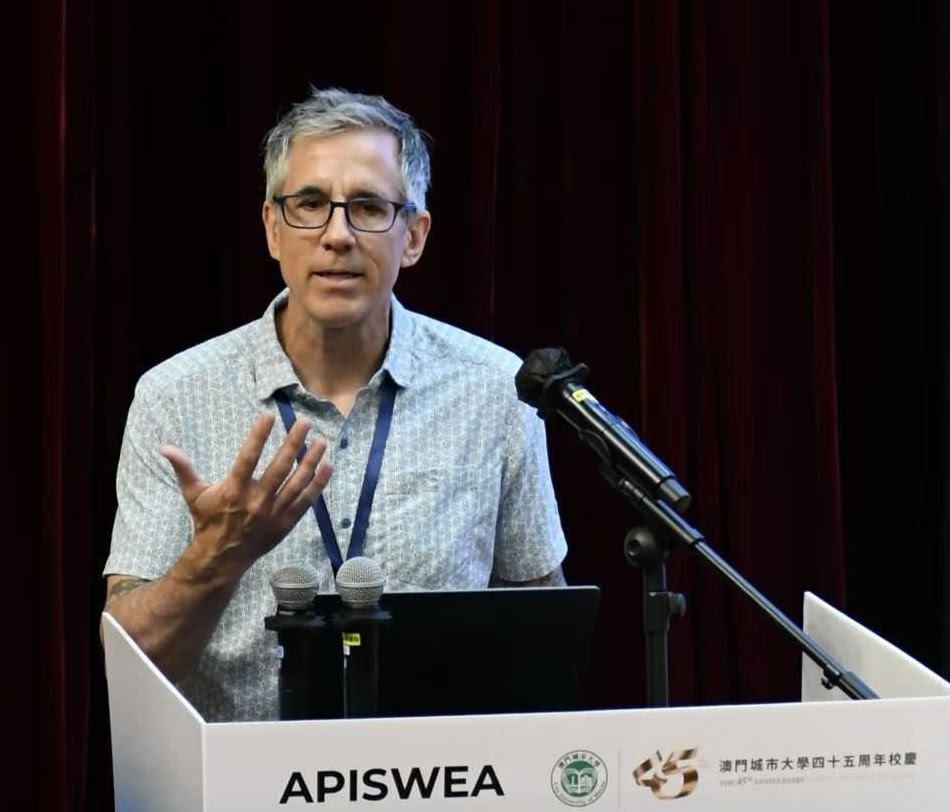
Fractional AI works the way fractional HR or a fractional CFO does. Organizations that cannot justify a full-time senior hire retain that expertise part-time: a defined relationship, senior-level judgment, a fraction of the cost. I provide fractional AI leadership — strategy, hands-on development, evaluation, and training — embedded in your organization and accountable to you, not to a software vendor.
What I build follows one discipline: small, local, and accountable. Small means models light enough to run on your own hardware, at a fraction of the energy and environmental cost of frontier systems. Local means you own your AI systems and your data outright — running on infrastructure you control, never handed to a cloud provider where you give up privacy and control. Accountable means every step of the work can be inspected and checked.
The hard part of AI isn't the AI. It's the data.
Most organizations sit on enormous collections of diverse, messy information — documents, records, spreadsheets, systems that don't talk to each other — that consume staff time instead of producing value. The real work is getting that data into the right shape, with the right processes around it. Then the automation is the easy part.
Brian Perron, PhD
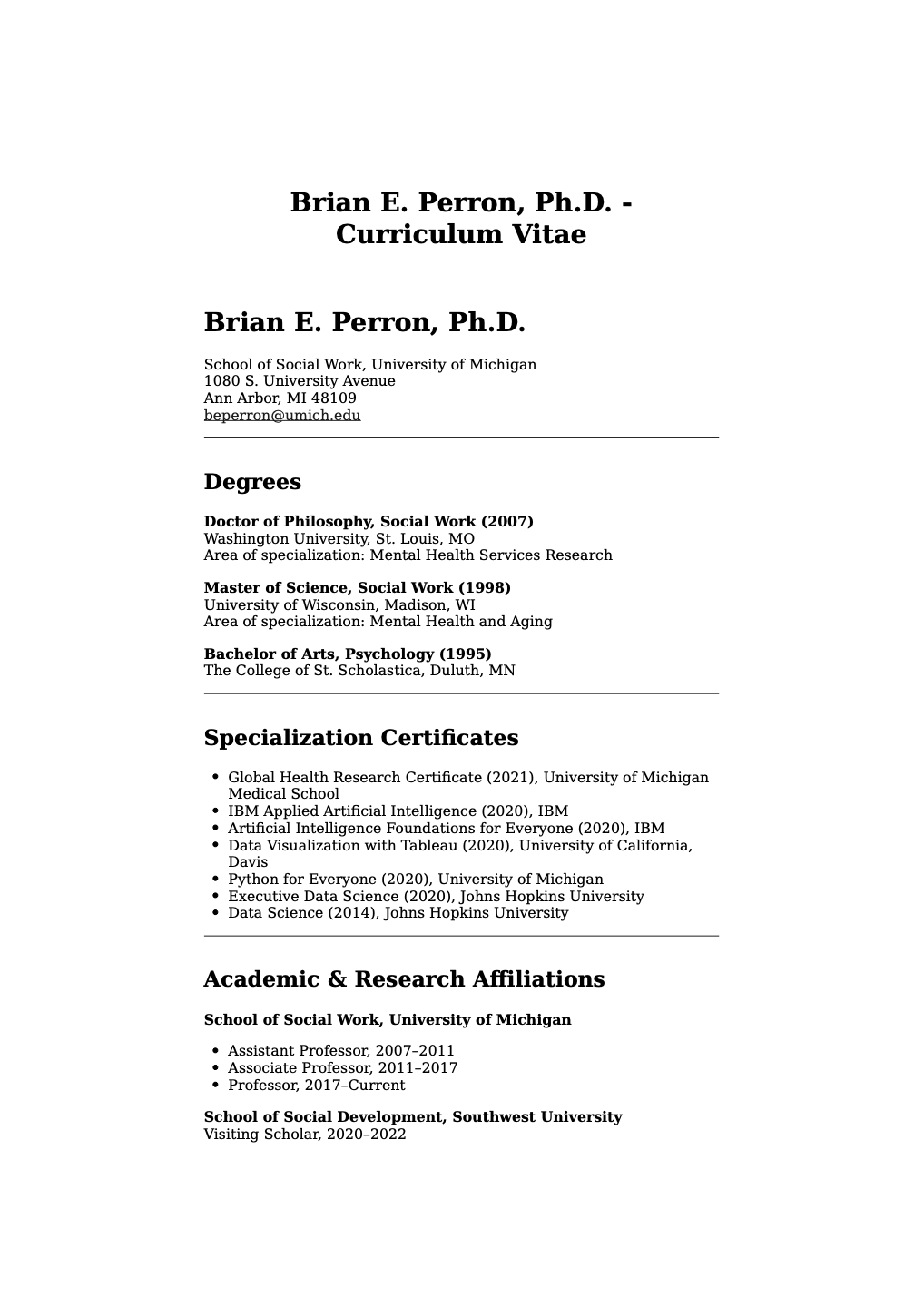
I am a Professor at the University of Michigan School of Social Work and a co-founder of the Child & Adolescent Data Lab. I bring twenty years of applied research and evaluation, including ten years building and evaluating AI and machine learning systems. My benchmarking studies of AI models are published and peer-reviewed. Bespoke systems I designed run in statewide production, handling sensitive administrative data every day. I have delivered AI training to professional audiences nationally and internationally, and maintain an active expert witness practice supporting document review across large collections.
Most organizations don't have an AI problem; they have a where-to-start problem. As your fractional advisor, I map where AI genuinely fits your operation, guide technology and purchasing decisions so you get value without vendor lock-in in a rapidly changing market, set the guardrails for safe use, and sequence the road from first pilot to daily practice — senior judgment, accountable to you, not to anyone selling software.
Every organization has work that consumes expert time without needing expert judgment: assembling reports, moving data between systems, summarizing case files, answering the same questions every month. I build efficient processes — typically data pipelines and automations — and decision-support dashboards fitted to how your organization actually works, so expert hours go where they're needed.
Your team shouldn't have to choose between confidentiality and capability. I deploy AI entirely on infrastructure you control — closing the quiet risk of staff pasting sensitive material into public chatbots — with purpose-built tools: Parse Vault for secure document intelligence, and a fine-tuned redaction model that protects sensitive information before it moves anywhere.
A litigation team's most expensive hours are usually spent finding things — the deposition line, the buried email, the inconsistency across records. I build secure document-intelligence systems that make large collections answerable in minutes, inside a privileged environment, so counsel's time goes to strategy. I provide consultation and instruction in the AI Law and Policy Clinic at the University of Michigan Law School.
Practical, hands-on sessions built around your organization's own tasks, not AI hype. Teams leave knowing which parts of their week can be safely automated; leadership leaves knowing what to greenlight and what to decline — drawing on training delivered to professional audiences nationally and internationally.
Built systems you can see. Each entry: the problem, the work, and where to find it.
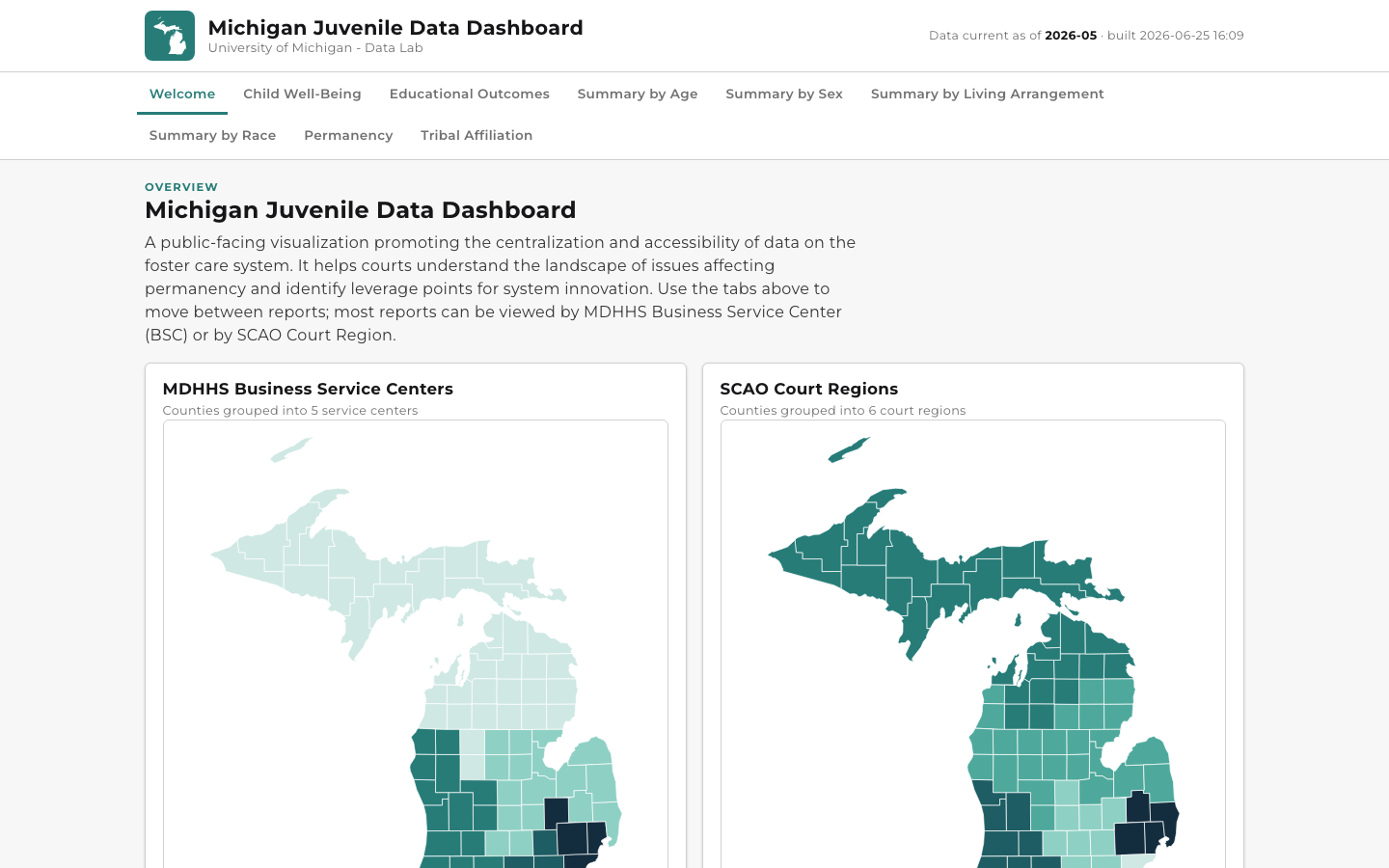
Behind the scenes, foster care data arrives from many sources, in different formats, on different schedules. Courts and the public had no unified, current view of the system.
Built the data pipeline that unifies and standardizes every incoming stream, and designed the dashboard's architecture and the automation behind it — published as an openly accessible site that helps courts understand the issues affecting permanency and identify leverage points for system innovation.
Michigan Juvenile Data Dashboard →
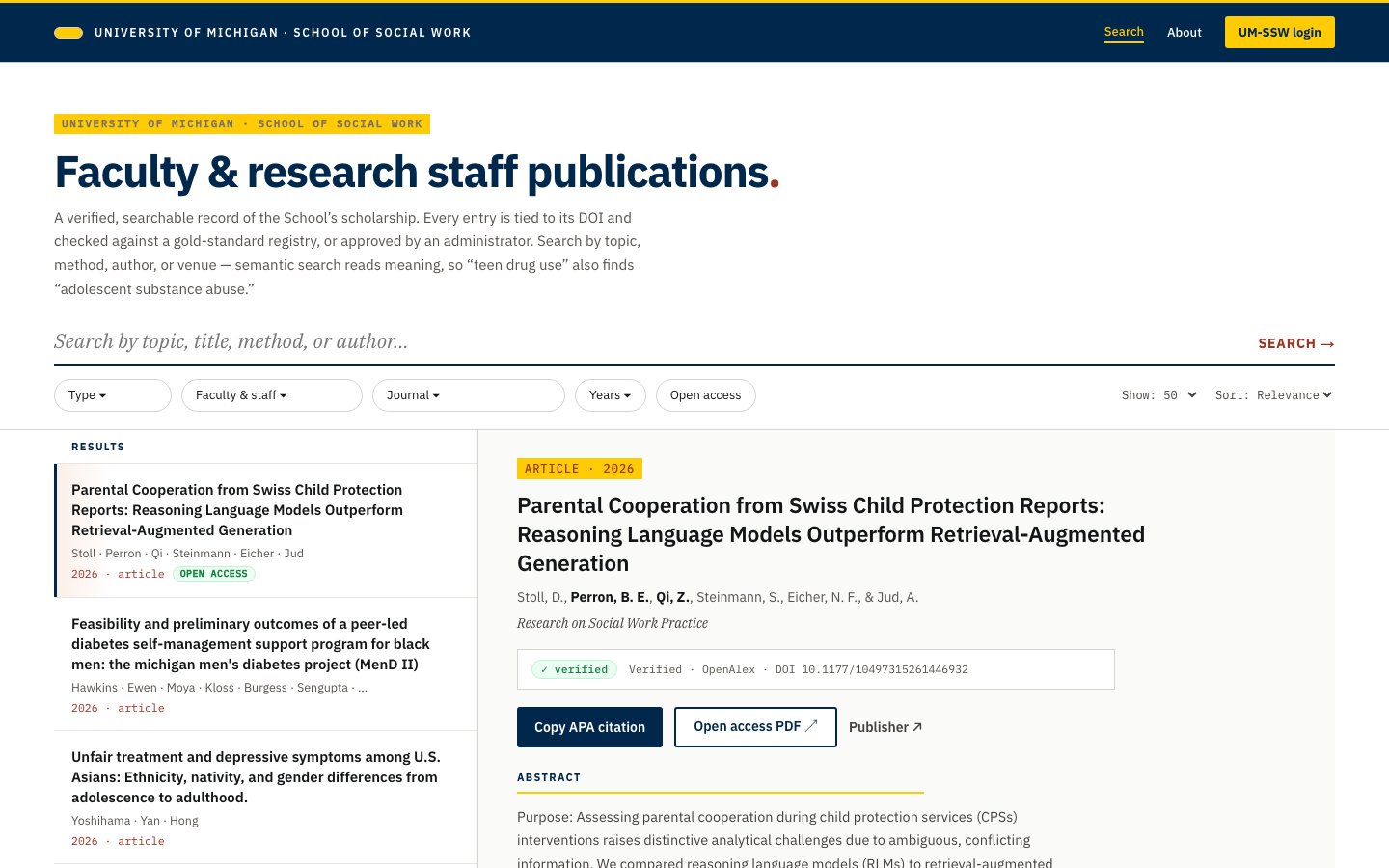
A school's scholarship was scattered across dozens of databases and systems — 71 researchers' work, discoverable nowhere in one place, and searchable only by exact keywords.
Built the weekly pipeline that gathers records from OpenAlex, Crossref, PubMed, Web of Science, and the university repository; verifies every entry against its DOI; and resolves duplicates and name conflicts. On top of it, a search that reads meaning — "teen drug use" finds "adolescent substance abuse." The AI is deliberately small: it only ranks relevance and cannot generate text, so nothing is ever invented.
Faculty & research staff publications →
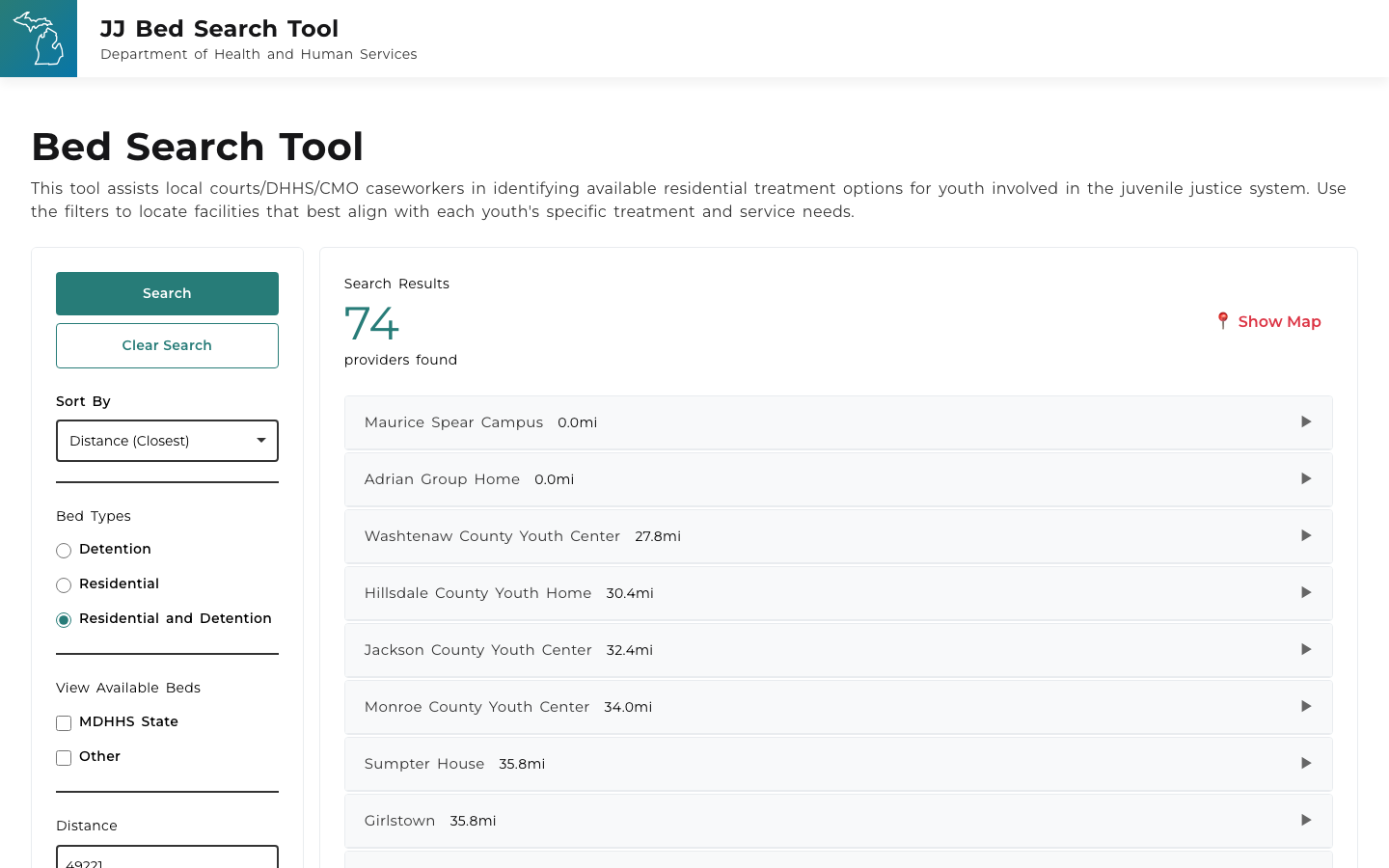
Courts and caseworkers placing youth involved in the juvenile justice system had no fast way to see which residential treatment facilities could take them — capacity information was scattered across a statewide system and stale by the time it was assembled.
Designed and architected the system — a comprehensive build plan covering the data flow from administrative records to a live search tool that lets courts, DHHS, and caseworkers filter facilities by bed type, distance, and each youth's treatment needs. Now operated by the Michigan Department of Health and Human Services.
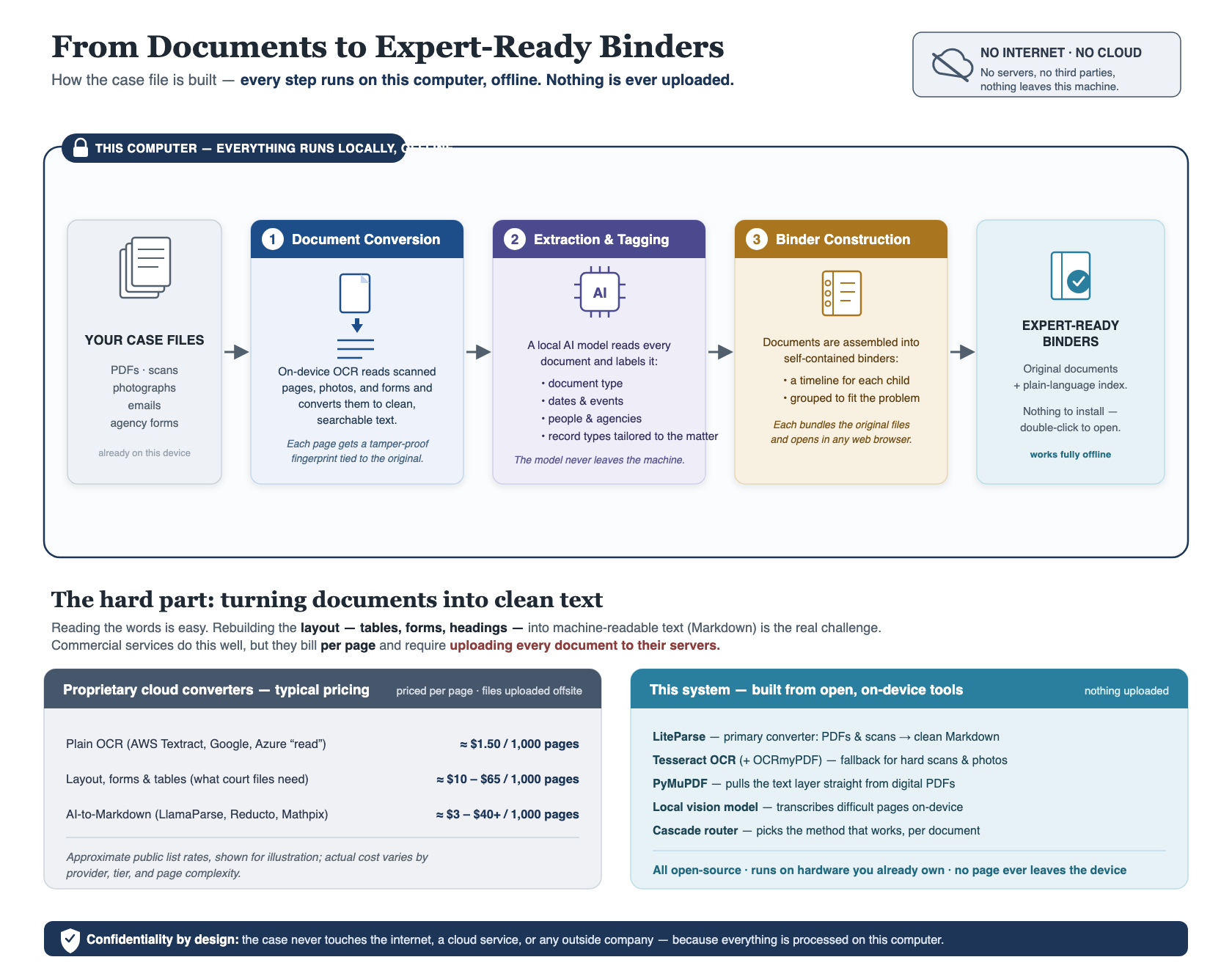
A legal matter arrives as boxes of unstructured documents — scanned PDFs, photographs, emails, agency forms — with no index and no accompanying documentation. The commercial tools that could process them bill per page and require uploading every document to their servers, which a confidential matter cannot allow.
Built Parse Vault: custom infrastructure for converting, indexing, and searching large collections of unstructured text, and for building data products on top — including self-contained evidence binders in which every fact traces to its source page. The entire system is local: no internet, no cloud processing, nothing ever uploaded. An illustrative case, built entirely from fictitious data: 25,000 documents in every condition — scans, photographs, emails, forms — become one coherent, searchable collection in which everything is retrievable, including the images, and every fact cites its source page; evidence binders assemble per person in the matter, without a single document leaving the room. These are bespoke applications for legal settings; no client data appears anywhere.
How it works — the fully local pipeline →
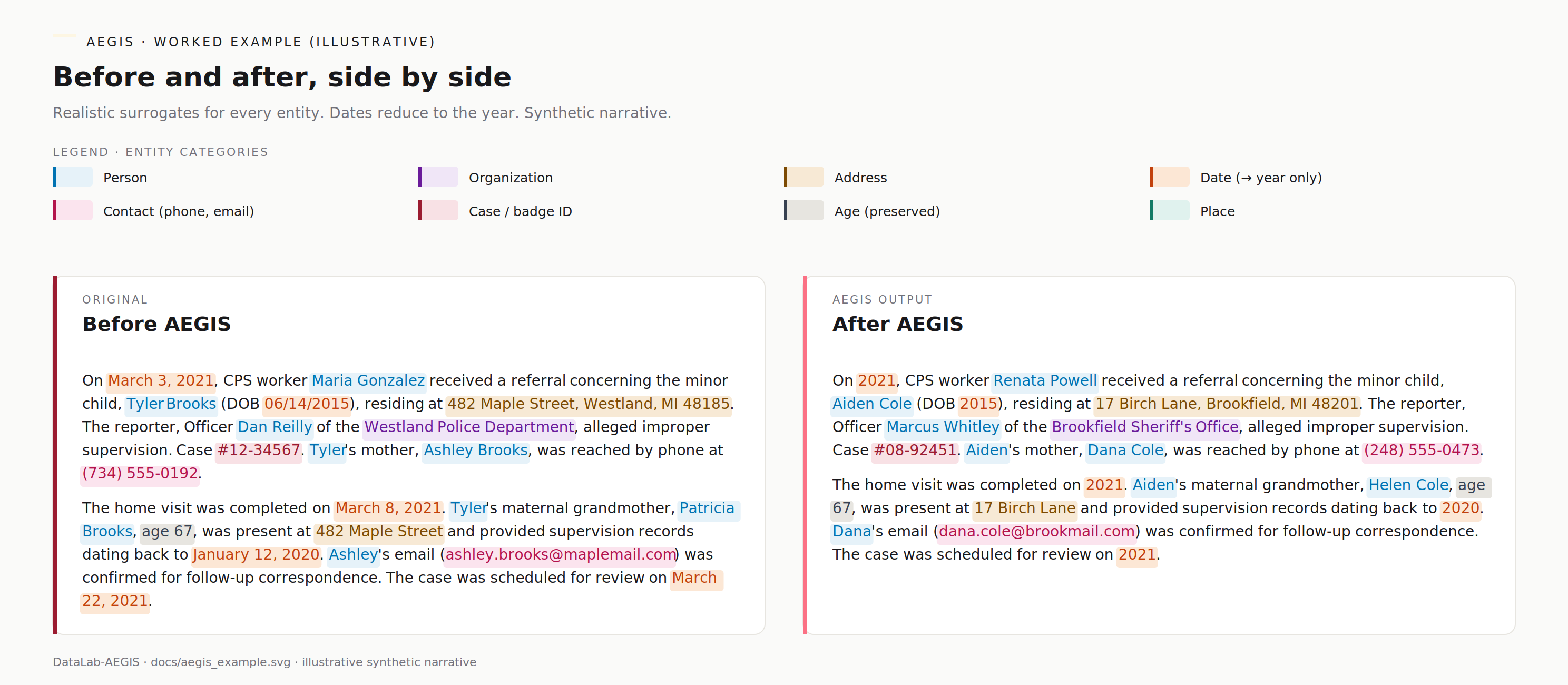
Child welfare records can't be shared or analyzed until identifiers are reliably removed — and the public de-identification tools, trained on web or clinical text, miss what these narratives actually contain: names behind role descriptors, court case numbers, placement IDs. Manual redaction can't keep up at scale.
Built AEGIS, a de-identification model fine-tuned specifically for Michigan's child-welfare narratives. It was trained entirely on synthetic data — roughly 70,000 generated examples, so no real identifier was ever used — and runs fully offline, replacing identifiers with realistic stand-ins. Evaluated head-to-head against nine public systems, AEGIS leads at 0.980 F1 on person names, ahead of the best general-purpose detector (0.950) and well ahead of standard tools like Microsoft Presidio (0.800).
AEGIS worked example — before & after →
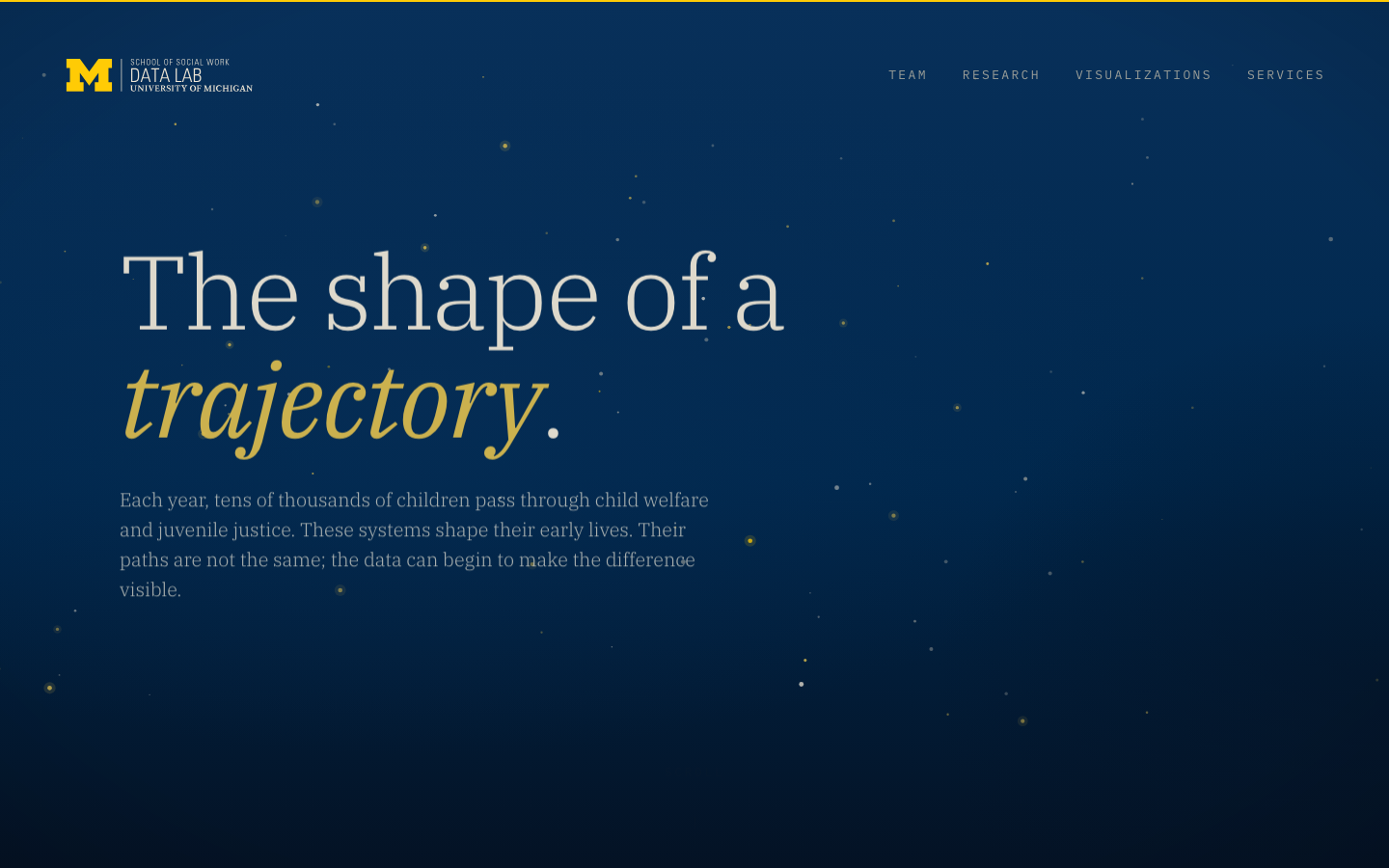
Tens of thousands of children pass through child welfare and juvenile justice systems each year, and the records that could reveal how those systems actually operate sit in administrative silos — sensitive, scattered, and unusable for research or decision-making without serious infrastructure.
Cofounded the Data Lab and built its data infrastructure — the foundation for ongoing system reporting and empirical research that has supported dozens of peer-reviewed studies, evaluations, and decision-support tools. The Lab now operates its own GPU cluster to process data and train local AI models, providing the highest level of data privacy and security.
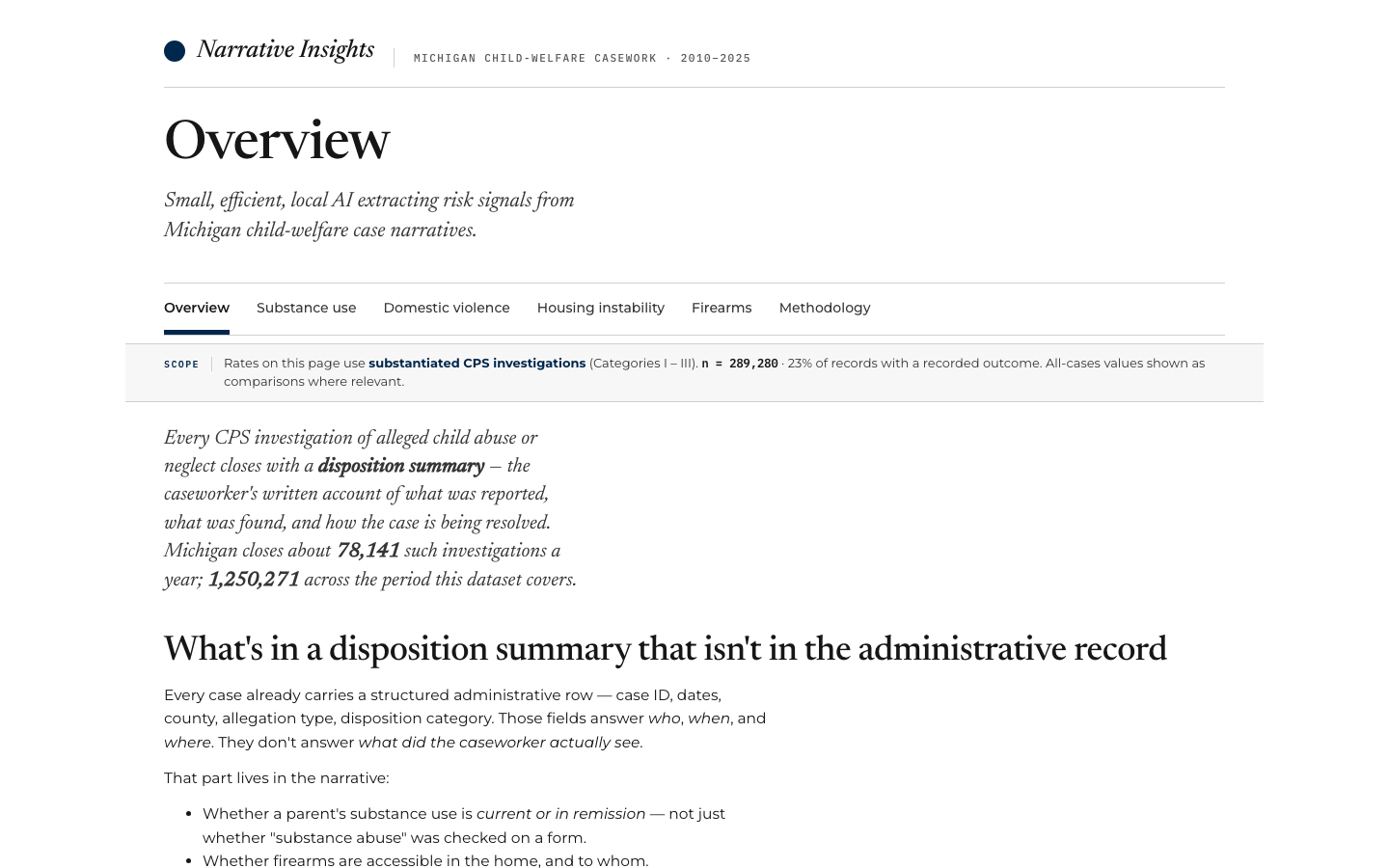
Every child-protective investigation closes with a written narrative — what the caseworker actually saw, in words rather than checkboxes. Across 1.3 million highly sensitive Michigan records, that insight was locked in unstructured text no human team could ever read at scale.
Trained a collection of local AI models to process the entire collection — extracting information from raw text, performing classifications with validation steps at every stage, and linking the results back to administrative data to reveal temporal and geographic trends. All of it on secure infrastructure: no record ever left the environment.
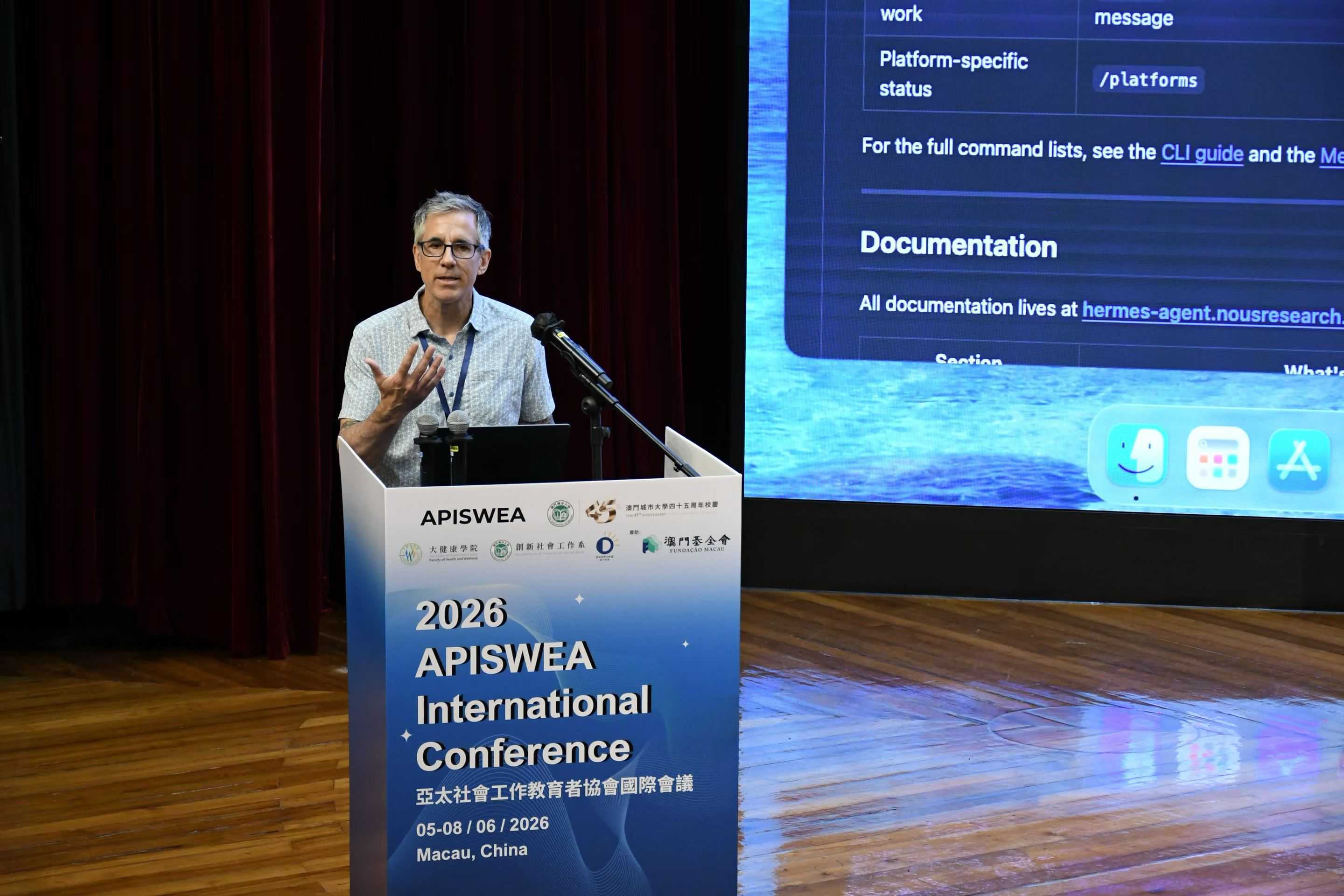
The 2026 International Conference of the Asia-Pacific Islands Social Work Educators Association (APISWEA), hosted at City University of Macau under the theme "AI and Innovation: Re-shaping Social Work Practice and Learning."
Delivered the keynote — "The Future of Social Work is Agentic: How AI Is Reshaping Roles Across Research and Practice" — followed by a half-day workshop demonstrating how to build and manage agentic workflows, hands-on.
2026 APISWEA International Conference →
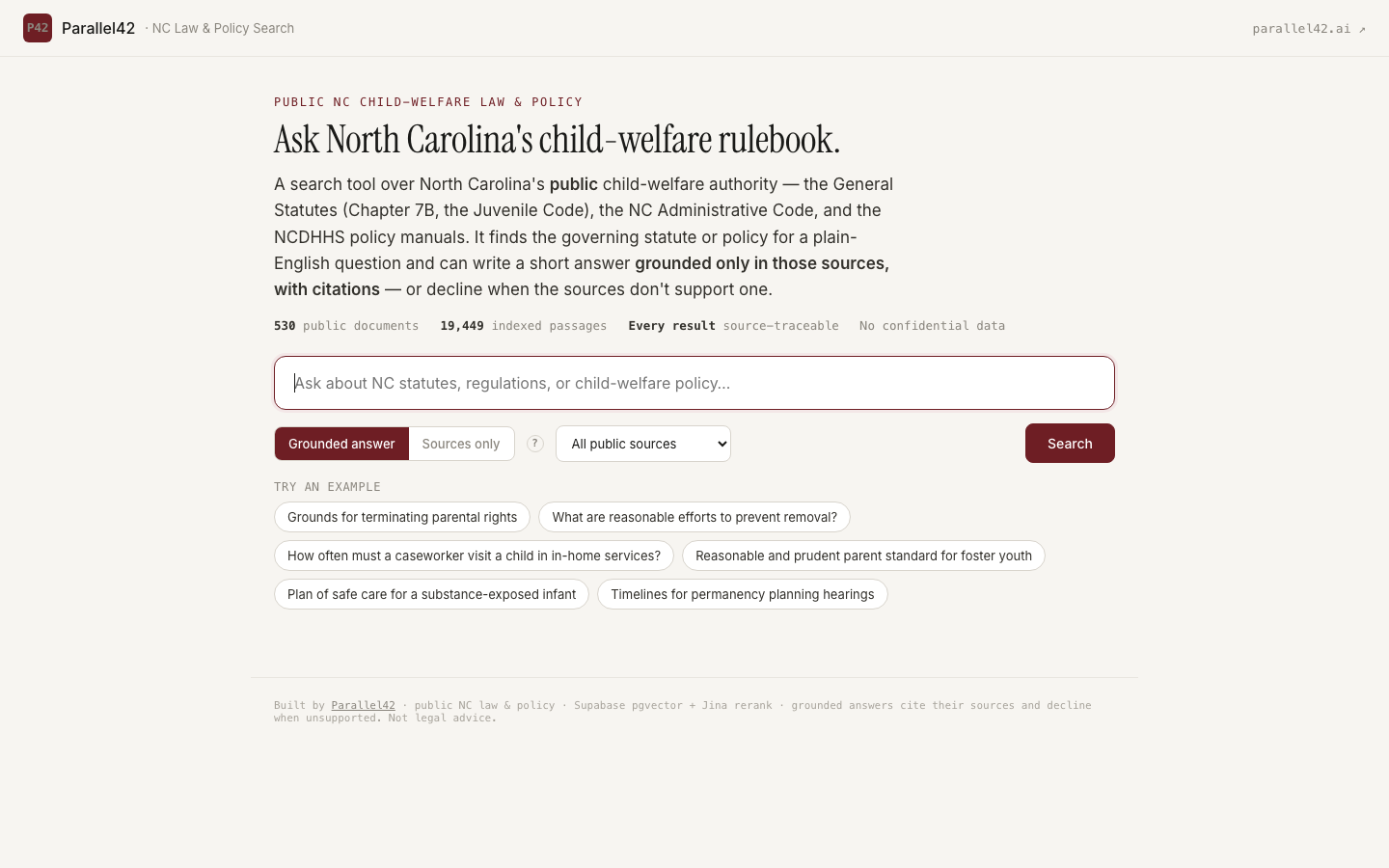
North Carolina's child-welfare rules live across the Juvenile Code, the Administrative Code, and the NCDHHS policy manuals — 530 documents no caseworker, attorney, or policymaker can hold in their head. General-purpose chatbots answer questions about them by guessing.
Built a retrieval system over 19,449 indexed passages of the public authority. Ask a plain-English question and it finds the governing statute or policy, writes a short answer grounded only in those sources with inline citations — and declines to answer when the sources don't support one. Every result is source-traceable; no confidential data involved.
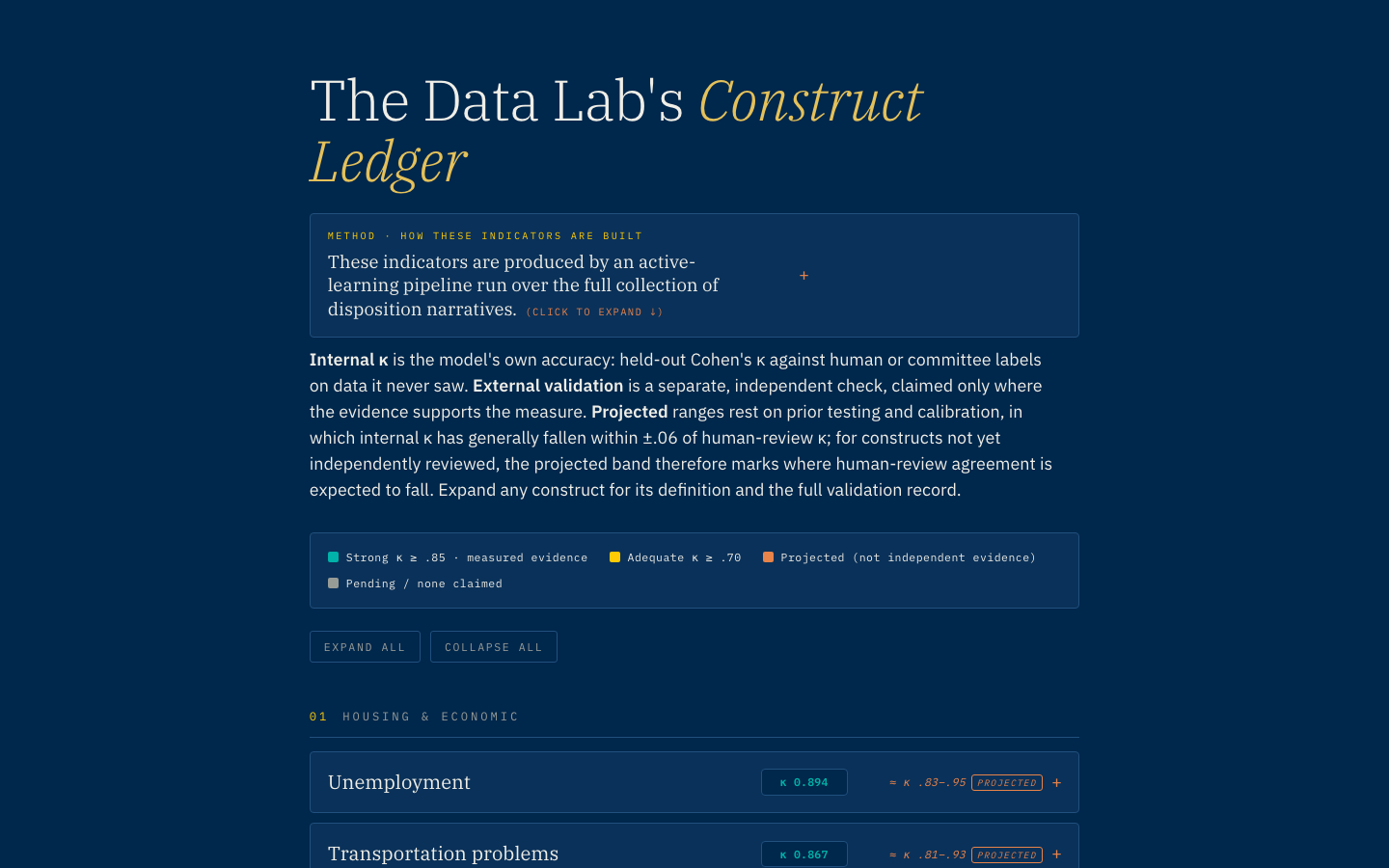
The most important facts in child-welfare cases — housing instability, violence, mental health, substance use — live in free-form narrative text, not in any database field. Across 1.3 million records, no amount of manual coding can turn that text into usable data.
Through many iterations of text analysis, built an active-learning pipeline that converts the full collection into 40+ standardized social and health indicators: small language models teach, a compact encoder model learns, and humans control the definitions and validation. Every indicator carries its own measured accuracy, checked against independent sources — CDC data, state police reports, SAMHSA records.
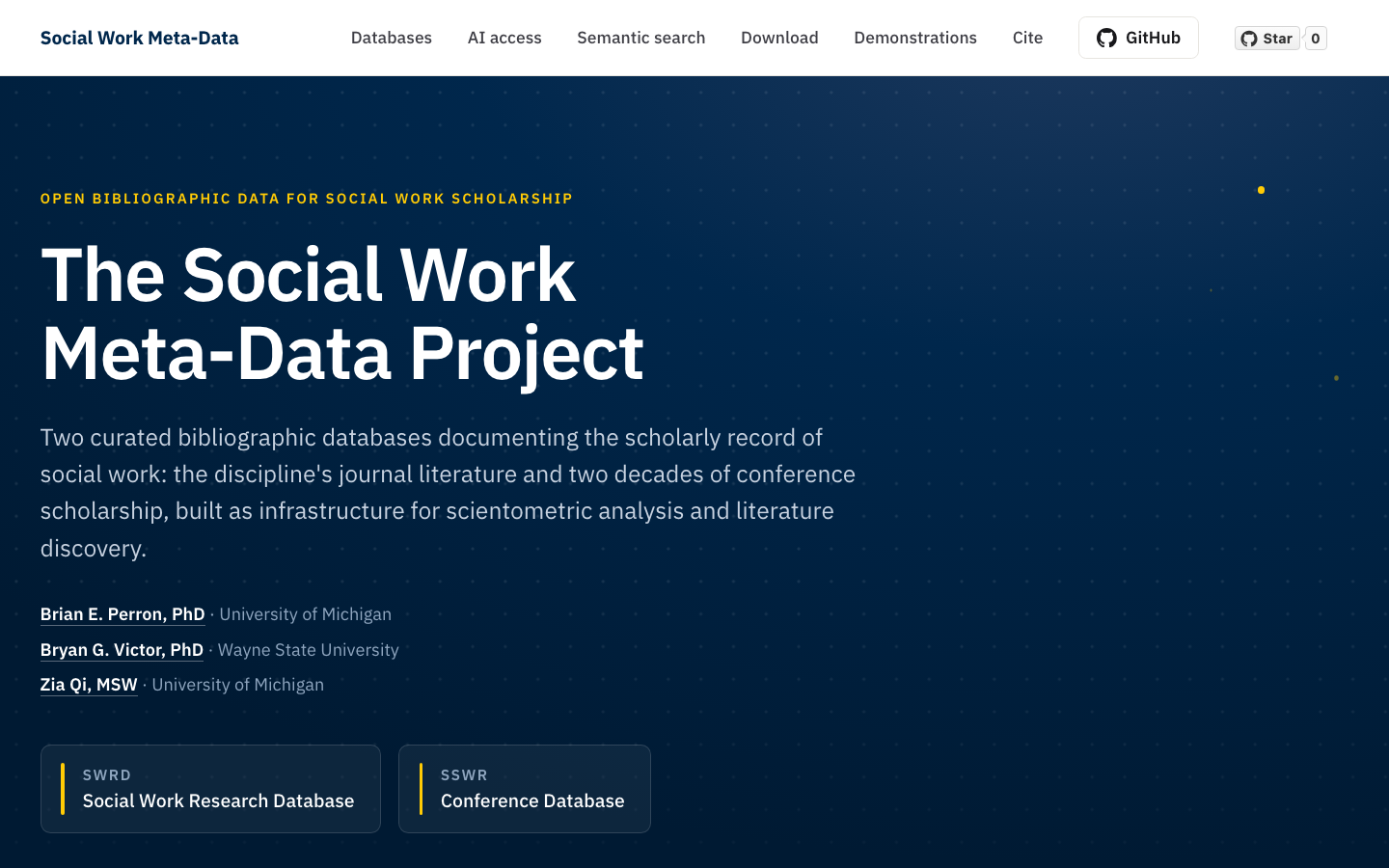
A discipline's scholarly record was scattered and unsearchable: journal articles indexed inconsistently across dozens of systems, and two decades of conference scholarship locked inside unstructured abstracts. No one could search it by meaning, analyze it at scale, or study how the field's knowledge was produced.
Built and published two curated, open databases documenting the discipline's output. The Social Work Research Database covers 62,602 research articles with abstracts across 88 journals (1989–2025), each classified for document type and methodology by a language-model procedure validated against human raters. The SSWR Conference Database covers 23,793 presentations (2005–2026) with author identities resolved across every year. Both are released AI-ready — semantic and keyword search, plus drop-in skill files that let any AI assistant query the data with no account or key — and free to download as CSV. The construction and validation are set out in a peer-reviewed publication in the Journal of the Society for Social Work & Research.
The Social Work Meta-Data Project →
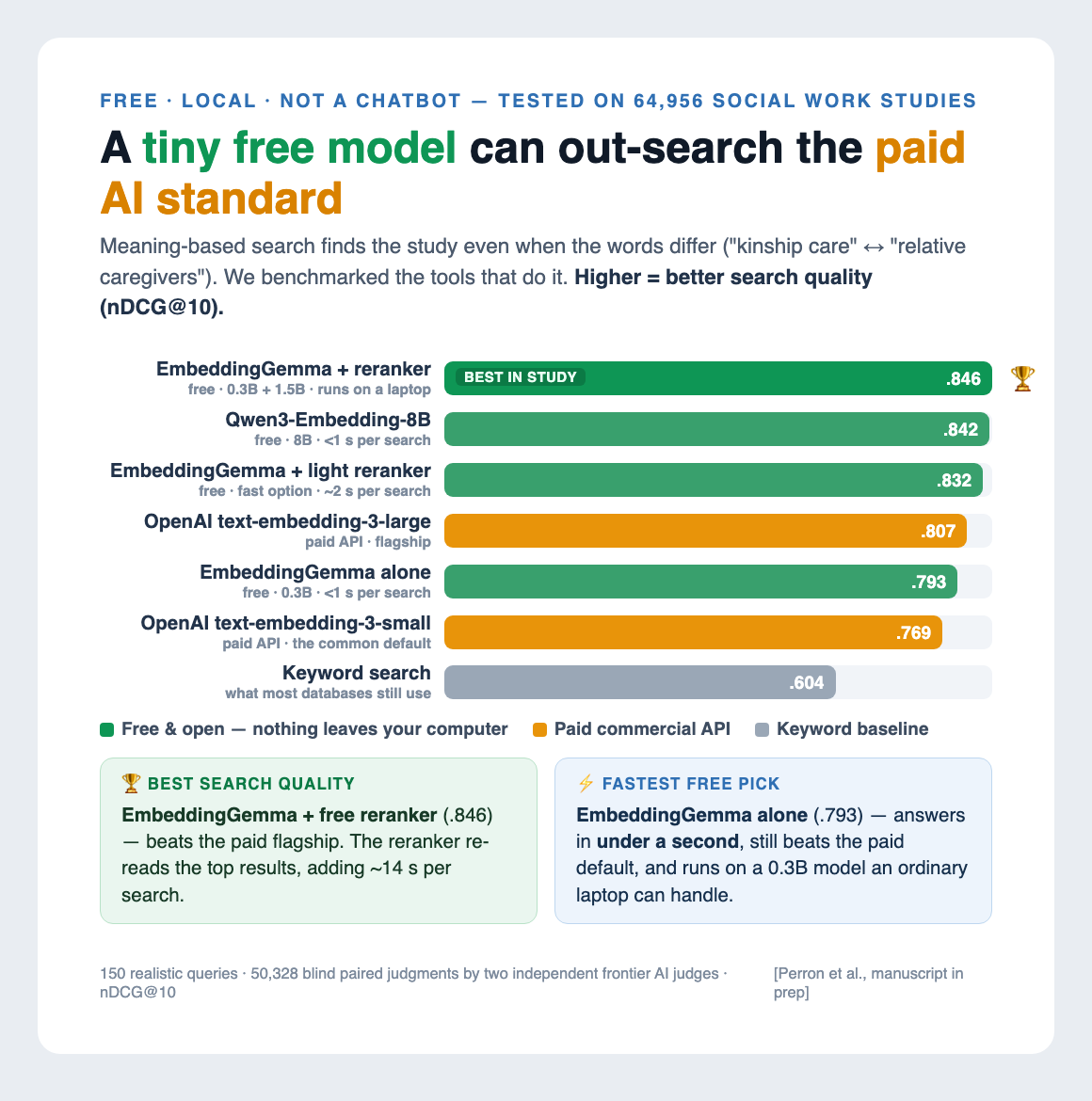
Organizations assume good AI search requires a paid API — sending their data out and paying per call, with the costs compounding and the dependence deepening. In specialized domains, that assumption is rarely tested.
Benchmarked the retrieval stacks head-to-head on 64,956 social work studies: 150 realistic queries, 50,328 blind paired judgments by two independent frontier-AI judges. A free 0.3-billion-parameter model with a free reranker scored .846 — beating OpenAI's paid flagship (.807) — and even running alone on an ordinary laptop it outperformed the paid default. This is the evidence I bring when helping organizations optimize their tooling to be cost-effective and AI-sovereign: free, local, and nothing leaves your computer.
The benchmark, visualized →
What are embeddings? — a plain-language explainer →
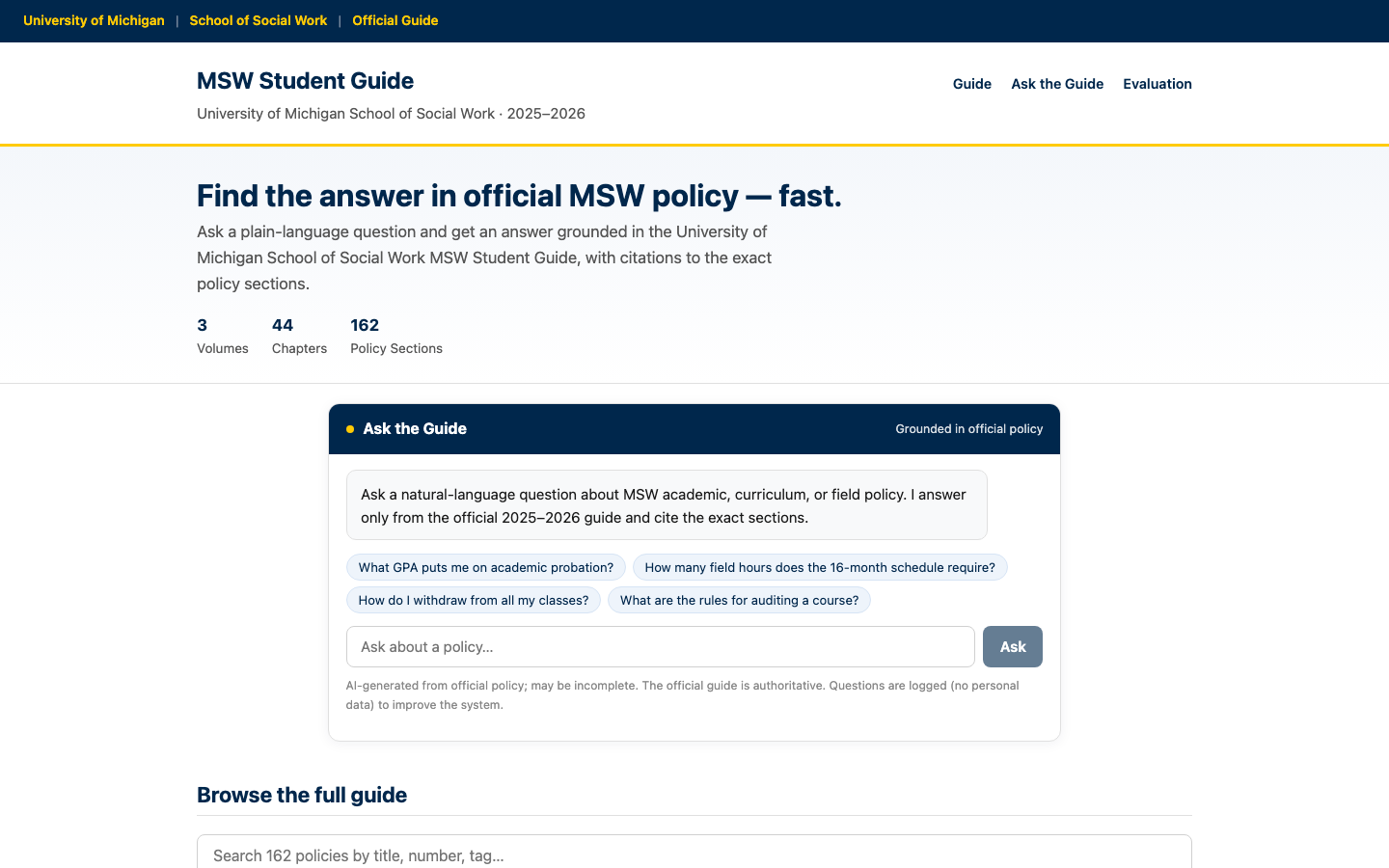
Every institution has them: long, static policy guides that answer everything and get read by no one. People ask staff the same questions the guide already answers, and staff hours go to looking up policy sections.
Converted a three-volume, 44-chapter MSW student guide into an interactive assistant that answers plain-language questions only from official policy, citing the exact sections — and declining when the guide doesn't cover the question. Then evaluated it the way research is evaluated: 18 model-and-configuration combinations compared systematically for accuracy, speed, and cost; 150 retrieval tests (100% recall@5), 49 judged answers across five quality dimensions (zero hallucinations), and 50 adversarial attacks (100% handled safely). The full evaluation is published on the site.
MSW Student Guide — Ask the Guide →
Twenty years of applied academic research: more than 200 peer-reviewed publications spanning mental health services, substance use, child welfare, juvenile justice, measurement, and — over the past decade — applied artificial intelligence.
My advice is grounded in a career of doing the work to publication standard — study design, measurement, evaluation, and evidence. The same rigor now goes into the AI systems I build and the organizations I guide.
References available upon request.
An applied social scientist with a strong technical background, I have provided AI advising and consulting to local small businesses and non-profits across human services, the legal system, the lumber industry, and educational settings. A firm built on data privacy does not put client names on a website.